
“The figure of the sensible port.” It is an ideal, a standard, the embodiment of all the qualities we demand of a good entrepreneur (…) “The reasonable port is always thinking about the success of its clients; prudence is its guide, and fulfilling its duty of ‘precaution’ comes first—it is the rule of its business. The port plans years in advance for its direction and carefully examines the terrain before expanding its capacity; it does not dawdle or get lost in contemplation when approaching the traps created by emerging hazards at the edge of its dock; it always records in the digital footprints of its operations as many details as appropriate; it never stores hazardous cargo for longer than prudent; it does not allow a vessel to berth unless it is seaworthy; it thoroughly investigates the good faith of each shipping company and cargo generator before agreeing to provide services, and it informs itself of the history and professional habits of its port service providers before contracting them; it does not believe in or repeat tavern gossip unless it has a solid basis to believe it true; it never acts prematurely before those ahead have fully vacated the hole that is its own target; it never asks too much from its shareholders, competitors, stevedores, or gantry cranes; in its business, it only seeks a modest profit that a small group of colleagues considers ‘fair,’ and regards its fellow merchants, agents, and goods with the degree of suspicion and caution that the law deems admirable; it never curses, gambles, or loses control; it always behaves with moderation, and even when disciplining its child, it considers the middle ground. It stands as a monument in our courts, calling in vain on its fellow citizens to order their lives according to its example […].”[1]
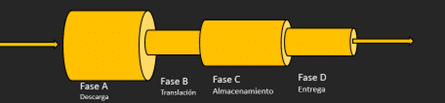
The services carried out at a port terminal are of “public interest” and must be provided in an “uninterrupted, continuous, and efficient” manner[2], under conditions of “safety”[3], fulfilling the “duty of precaution” in the conduct of a “specialized” business, since the work performed constitutes a “Hazardous Activity”[4].
Gráfico I. Representación flujo de carga de un terminal marítimo.[5]
Maintaining the continuity, efficiency, and safety of port operations ensures the constant flow of goods, helping to sustain a nation’s competitiveness, economy, trade, and efficient logistics. Continuous port operations are essential for the security and efficiency of the supply network, as well as for product price stability and food security. [6]
Any disruption of port activity[7] caused by an incident within port facilities, in access channels to the dock, or related to political and natural risks triggers a chain of negative effects that impact the industry and the economy at large. Therefore, it is an issue of concern not only for port operators but also for governments, businesses, and society as a whole.
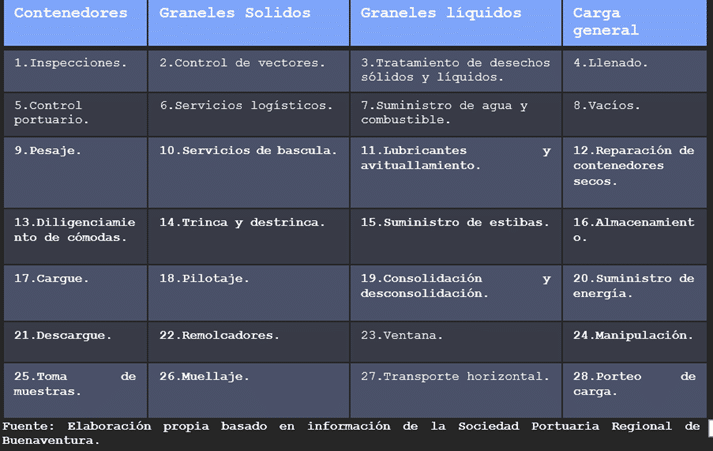
The users of the services provided by ports and their operators include shipping companies, importers and exporters, freight forwarders, land carriers, logistics operators, customs authorities, and other service companies. The services provided within a port are numerous, generate risks and hazards, and include the following:
Table 1. Some Types of Port Services Provided at a Terminal [8]
The purpose of this article is not to explain the civil liability regime applicable when the plaintiff/victim (shipowner, shipper, exporter, importer, third parties, etc.) suffers harm caused by the defendant/perpetrator (port, port operator) due to their action, omission, or breach of an obligation in the direct execution of a port service. What we aim to convey is the importance for a port terminal to incorporate into its technical conditions regulations[9] and port expansion plans[10] the concept of the duty of “Precaution” as a best practice to prevent port operations from experiencing disruptions that impact the economy and the port community[11].
The duty of “precaution” that the port and its operators must observe can be defined as the professional and moral obligation of an entrepreneur in a specialized industry to act with due diligence, discretion, and caution in order to avoid or prevent inconveniences, difficulties, or damages that may arise.[12]
Grafica II.[13]
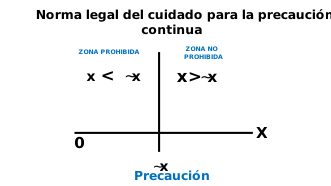
<In Graph II, we denote precaution by the continuous variable x, so that larger values of x correspond to higher levels of precaution. Generally, the plaintiff (exporter, importer of goods, shipowner, freight forwarder, etc.) in a negligence lawsuit must demonstrate that the defendant (port, port operator) breached an obligation owed to the plaintiff. A duty to act with care is a legal standard prescribing the minimum acceptable level of “precaution.” In Graph II, ~x denotes the legal standard. Precaution below ~x violates the duty of care, while precaution equal to or above ~x satisfies the duty of care. The “precaution” level ~x divides the graph into two zones: a permitted zone and a prohibited zone. Therefore, x < ~x implies that the actor is at fault, while [x ≥ ~x] implies that the actor is not at fault, where x indicates the actual amount of precaution taken by the defendant/perpetrator. Port activities are constantly evolving, transforming and generating additional port risks (automation of equipment, digitization of processes, sustainability, increased vessel capacity, congestion, etc.), requiring the implementation of measures to prevent incidents and avoid congestion[14], with the primary objective of maintaining continuity in service delivery. Examples of such measures include:
- Improvement of cargo handling techniques.
- Streamlining procedures for the removal of high-risk cargo.
- Reducing free storage time in transit warehouses and providing the construction of stationary cargo warehouses.
- Creation of an information silo related to frequent and severe loss events that have impacted port operations.
- Continuous training of personnel on safety procedures, cargo handling, and emergency response.
- Equipment maintenance: performing regular and thorough maintenance of all equipment and machinery used in the terminal to prevent failures.
- Emergency plans: develop and practice emergency plans that include procedures to respond to spills, fires, and other crises.
- Regular inspections: conduct routine inspections of facilities and operations to ensure compliance with safety standards and identify potential areas for improvement.
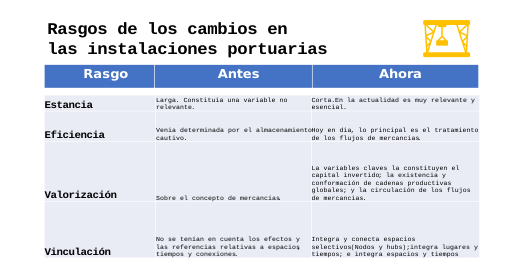
Implementing a “Precaution” strategy not only protects people and the environment, but also contributes to the sustainability, economic viability, and efficiency of port operations, as follows:
- Protecting assets by reducing claims for breach of contractual obligations resulting in damages to third parties.
- Environmental protection by reducing the likelihood of incidents that could impact the marine ecosystem.
- Reputation: fosters a positive image by demonstrating a commitment to safety and sustainability.
- Improves operational efficiency by reducing disruptions.
- Reduces the impact on inflation by limiting cost transfers to end consumers caused by inefficiencies in the distribution logistics network.
- Costs: rationalizes insurance premium expenses by preventing costly accidents and infrastructure damage.
- Include the concept of “Precaution” as a best practice in port operations.
[1] Adapted from the famous parody of the reasonable person taken from the essay titled “The Reasonable Man” by Lord A.P. Herbert.
[2] […]las actividades portuarias desempeñan un papel de vital importancia en el desarrollo de nuestro país. su ejercicio está sometido al cumplimiento de las metas de comercio exterior que se fijen en el plan de desarrollo económico y social. Una economía que pretenda insertarse en el ámbito internacional, debe contar con un eficiente, regular y pemante servicio portuario.[…]
[…]port public services are provided with regularity, efficiency, and continuity […]
Moreno A, Domingo Bernardo. Estatuto de puertos marítimos, Port Law Collection, Bogotá, Universidad Externado de Colombia, 1995, pp. 8, 14.
[3] […]the flow of cargo in the transfer between the maritime and land transport systems, and vice versa, is regular, efficient, economical, and safe […]
Macdonel Martinez, Guillermo. Pindter Vega, Julio. Herrejon de la Torre, Luis. Piza Ortiz, Juan. Lopez Gutierrez, Hector. Ingenieria marítima y portuaria, México D.F., Alfaomega, 2009, p. 248
Tamayo Jaramillo, Javier. Treatise on Civil Liability, Volume 1, Bogotá, Legis, 2018, p. 935
[5] […] Flujo de importación en tráfico de altura y llegadas en tráfico de cabotaje. […]
Macdonel Martínez, Guillermo. Pindter Vega, Julio. Herrejon de la Torre, Luis. Piza Ortiz,
Juan. López Gutiérrez, Héctor. Ingeniería marítima y portuaria, México D.F., Alfaomega, 2009, p. 249
[6] […] To reduce food losses in emerging markets, governments need to invest more in infrastructure and transportation; and it is necessary to have better communication among all parties in the supply chain, including the efficiency and continuity of port terminals.[…]
For a common goal: food security in emerging markets. Sigma No. 1/2013, Swiss Re.
[7] […] Port activities include the construction, operation, and administration of ports, port terminals; landfilling, dredging, and ocean engineering works; and, in general, all those carried out in ports and port terminals, on docks, in constructions that exist on beaches and low tide areas, and on riverbanks where there are port facilities.
Moreno A, Domingo Bernardo. Statute of maritime ports, port law collection, Bogotá, Universidad Externado de Colombia, 1995, P.1
[8] Tapia E., Diomedes. Barrientos, Enoc. Solar, Celmira Rosa. Contabilidad de gestión para el sector portuario marítimo y fluvial, ECOE, 2014, P.31
[9] […] Technical regulations are rules that govern the operational details of ports; that is, they deal with issues such as berthing priorities, services to be provided to ships, periods of stay in port, industrial safety issues, etc. […]
Gutiérrez Herrán, Oscar Fabian, Pontificia Universidad Javeriana, Ibañez,2024, P.79
[10] One of the objectives of port expansion plans is: […] 3—To reduce, for the benefit of the national consumer, the impact of port costs on the prices of domestic goods with foreign components and imported goods, since when an incident occurs, ports may pass the cost of their losses onto their fees, affecting consumers.
Moreno A, Domingo Bernardo. Estatuto de puertos marítimos, Port Law Collection, Bogotá, Universidad Externado de Colombia, 1995, p. 12.
[11] […] The port community is responsible for coordinating the services provided to the various vessels that dock at the port of a Regional Port Authority (RPA). This community is composed of the different companies registered with the port authority, which aim to efficiently provide port services and attend to their clients.
Fillol, Giner. Ubal Pontet, Felliu, Ripoll, 2007.
[12] Duty. To be obligated to something by divine, natural, or positive law.
Caution. Reserve, caution to avoid or prevent inconveniences, difficulties or damages that may be feared.
Essential Dictionary of the Spanish Language, Royal Spanish Academy, 2006.
[13] Fuente: Cooter, Robert D. Ulen Thomas. Derecho y economía, Fondo de Cultura Económica, Mexico D.F., 2016, P. 271
[14] […] los siniestros, inadecuadas instalaciones portuarias y de transporté, así como el aumento del volumen del trafico de carga producen el congestionamiento portuario […]
Congestion results in the waste of human and physical resources when commercial vessel fleets are waiting idly in port […]